
Aug 4, 2026 buying guide &News
Why Scooter Controller Burns Out
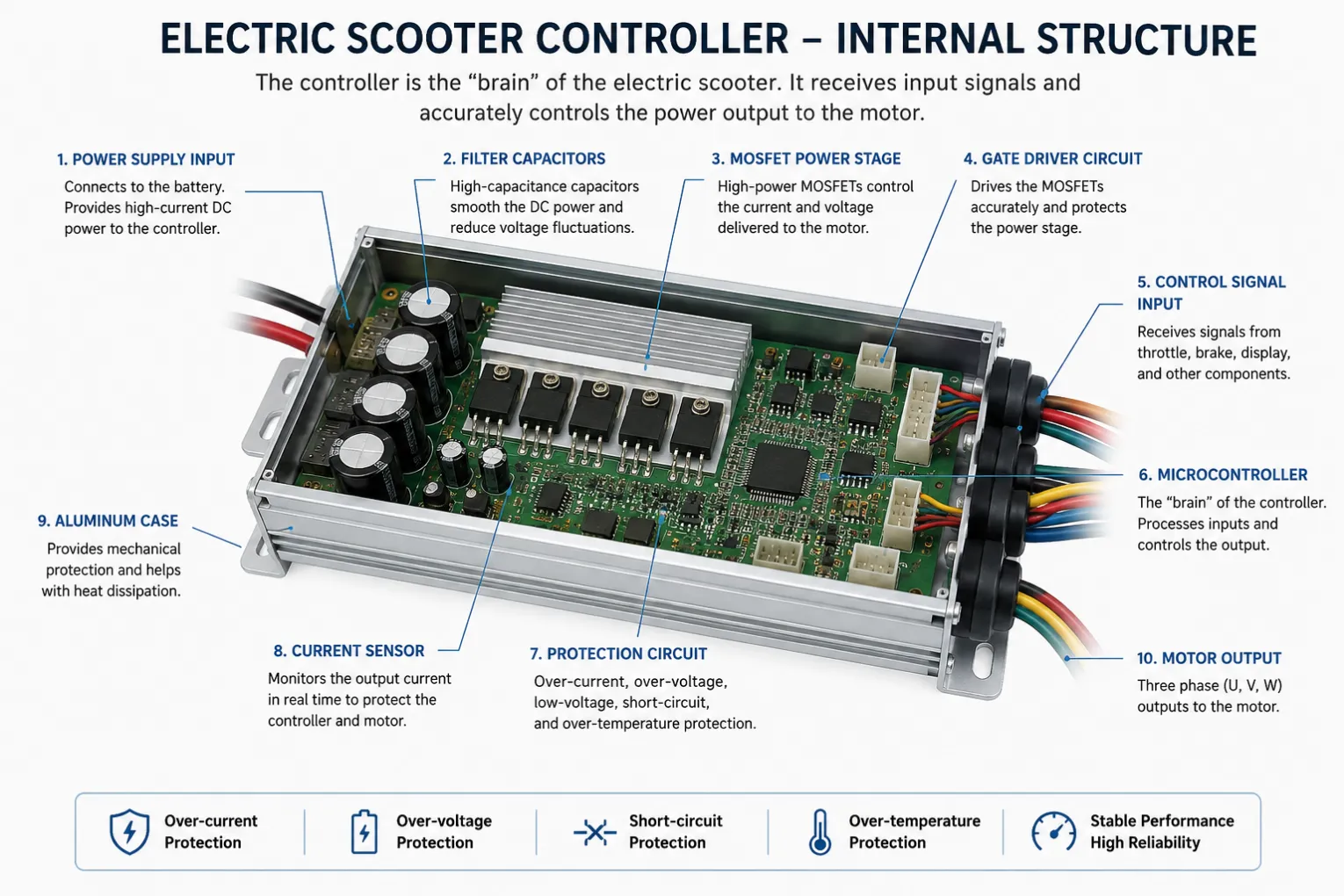
Why Scooter Controller Burns Out: 10 Common Causes and How to Prevent Controller Failure
If your electric scooter suddenly loses power, jerks during acceleration, or stops working completely, the controller is often the first component to inspect. A burnt scooter controller is one of the most common issues affecting electric scooters, e-bikes, and electric tricycles.
For distributors, repair shops, fleet operators, and OEM buyers, understanding why a scooter controller burns out is essential for reducing maintenance costs, extending vehicle lifespan, and improving customer satisfaction.
In this guide, we'll explain the most common reasons for controller failure, how to identify early warning signs, and practical ways to prevent expensive repairs.
What Does an Electric Scooter Controller Do?
The controller is often called the "brain" of an electric scooter. It regulates the flow of electricity from the battery to the motor while controlling speed, acceleration, braking, and safety protection.
A high-quality controller ensures:
- Smooth acceleration
- Stable motor performance
- Battery protection
- Efficient power delivery
- Longer motor life
When the controller fails, the entire electrical system may stop functioning.
Signs of a Burnt Scooter Controller
Before replacing the controller, look for these common symptoms:
- Scooter won't start even though the battery is fully charged
- Sudden loss of power while riding
- Motor jerks during acceleration
- Burnt smell coming from the controller box
- Controller casing becomes extremely hot
- Error codes appear on the LCD display
- Fuse repeatedly blows
- Scooter cuts off under heavy load
Early diagnosis can prevent damage to other expensive components such as the motor or battery.
10 Common Reasons Why Scooter Controllers Burn Out
1. Overheating
Heat is the number one enemy of electronic controllers.
Continuous climbing, carrying heavy loads, or riding at full throttle for long periods causes the MOSFETs inside the controller to generate excessive heat. Without sufficient cooling, internal components eventually fail.
Prevention
- Choose controllers with aluminum heat sinks.
- Ensure proper ventilation.
- Avoid continuous overload operation.
2. Incorrect Battery Voltage
Installing a battery with a higher voltage than the controller is designed for can instantly damage internal circuits.
For example:
- Using a 72V battery with a 60V controller
- Charging voltage exceeding controller specifications
Always match the battery voltage with the controller rating.
3. Low-Quality Controllers
Many low-cost controllers use inferior MOSFETs, capacitors, and PCB materials.
Poor-quality components often lead to:
- Poor heat dissipation
- Weak current protection
- Short service life
Although cheaper initially, they usually result in higher maintenance costs.
4. Motor Overload
A controller designed for a 1000W motor may burn out if continuously driving a 1500W or 2000W motor.
Heavy cargo, steep hills, and overloaded vehicles all increase current demand beyond the controller's capacity.
Always match the controller with the motor's rated power.
5. Water Damage
Water entering the controller enclosure can cause:
- Short circuits
- Corrosion
- Electrical leakage
- Instant controller failure
This commonly happens after riding in heavy rain or washing the scooter with high-pressure water.
Choose controllers with reliable waterproof sealing for demanding environments.
6. Poor Wiring Connections
Loose connectors or damaged wiring increase electrical resistance, generating excessive heat.
Common issues include:
- Loose battery connectors
- Damaged phase wires
- Poor grounding
- Oxidized terminals
Regular inspection helps prevent unnecessary failures.
7. Poor Heat Dissipation
Controllers installed inside sealed compartments without airflow cannot release heat efficiently.
Fleet scooters used for food delivery often experience this problem because they operate continuously for many hours.
Adding ventilation or relocating the controller can significantly improve cooling.
8. Excessive Current
Frequent rapid acceleration, climbing steep roads, or carrying overweight loads forces the controller to output current beyond its design limits.
Repeated overcurrent conditions eventually damage power transistors.
Choosing a controller with adequate current capacity is essential for commercial applications.
9. Poor Battery Quality
An unstable battery may output fluctuating voltage, causing stress on the controller.
Problems include:
- Voltage spikes
- Cell imbalance
- Damaged Battery Management System (BMS)
High-quality lithium batteries help protect the controller and motor.
10. Incorrect Installation
Improper installation can easily destroy a controller.
Typical mistakes include:
- Reversed battery polarity
- Incorrect Hall sensor wiring
- Wrong phase wire sequence
- Loose connectors
Always follow the wiring diagram provided by the manufacturer.
How to Prevent Scooter Controller Failure
Preventive maintenance is much less expensive than replacing damaged controllers.
Here are several practical recommendations:
- Use the correct battery voltage.
- Match controller power with motor specifications.
- Avoid prolonged overload operation.
- Keep electrical connectors clean and tight.
- Protect the controller from water exposure.
- Install controllers with efficient heat dissipation.
- Perform regular inspections.
- Purchase controllers from reliable manufacturers.
For commercial fleets and cargo electric vehicles, selecting industrial-grade controllers can dramatically improve reliability.
How to Choose a High-Quality Scooter Controller
When sourcing controllers for OEM projects or wholesale distribution, pay attention to the following features:
- High-efficiency MOSFET components
- Intelligent temperature protection
- Over-current protection
- Short-circuit protection
- Waterproof enclosure
- Stable firmware
- High conversion efficiency
- OEM and ODM customization options
A quality controller not only improves vehicle performance but also reduces warranty claims and after-sales costs.
Frequently Asked Questions
Can a burnt scooter controller be repaired?
Minor component failures may be repairable by experienced technicians. However, if the PCB or multiple MOSFETs are severely damaged, replacement is usually the safer and more cost-effective option.
How long does a scooter controller normally last?
A well-designed controller can typically last between 3 and 8 years, depending on riding conditions, maintenance, operating temperature, and product quality.
Can overheating permanently damage the controller?
Yes. Repeated overheating accelerates the aging of electronic components and may permanently damage MOSFETs, capacitors, and circuit boards.
Does using a larger motor require a new controller?
Yes. The controller should always be matched to the motor's voltage, rated power, and maximum current requirements to ensure reliable performance.
Conclusion
Whether you are an electric scooter manufacturer, distributor, fleet operator, or repair professional, investing in high-quality controllers and following proper installation and maintenance practices can significantly reduce downtime and repair costs.
At Lubon Motor, we supply reliable electric scooter controllers, motors, chargers, batteries, and a full range of electric vehicle spare parts for OEM and wholesale customers worldwide. Our products are designed for durability, stable performance, and long-term commercial use.
If you're looking for a trusted electric scooter parts supplier, contact our team to discuss your project and discover our complete one-stop EV parts solution.