
How to Choose the Right Electric Vehicle Controller?
A good electric scooter controller is not just an electrical component — it is the key to vehicle performance and reliability.
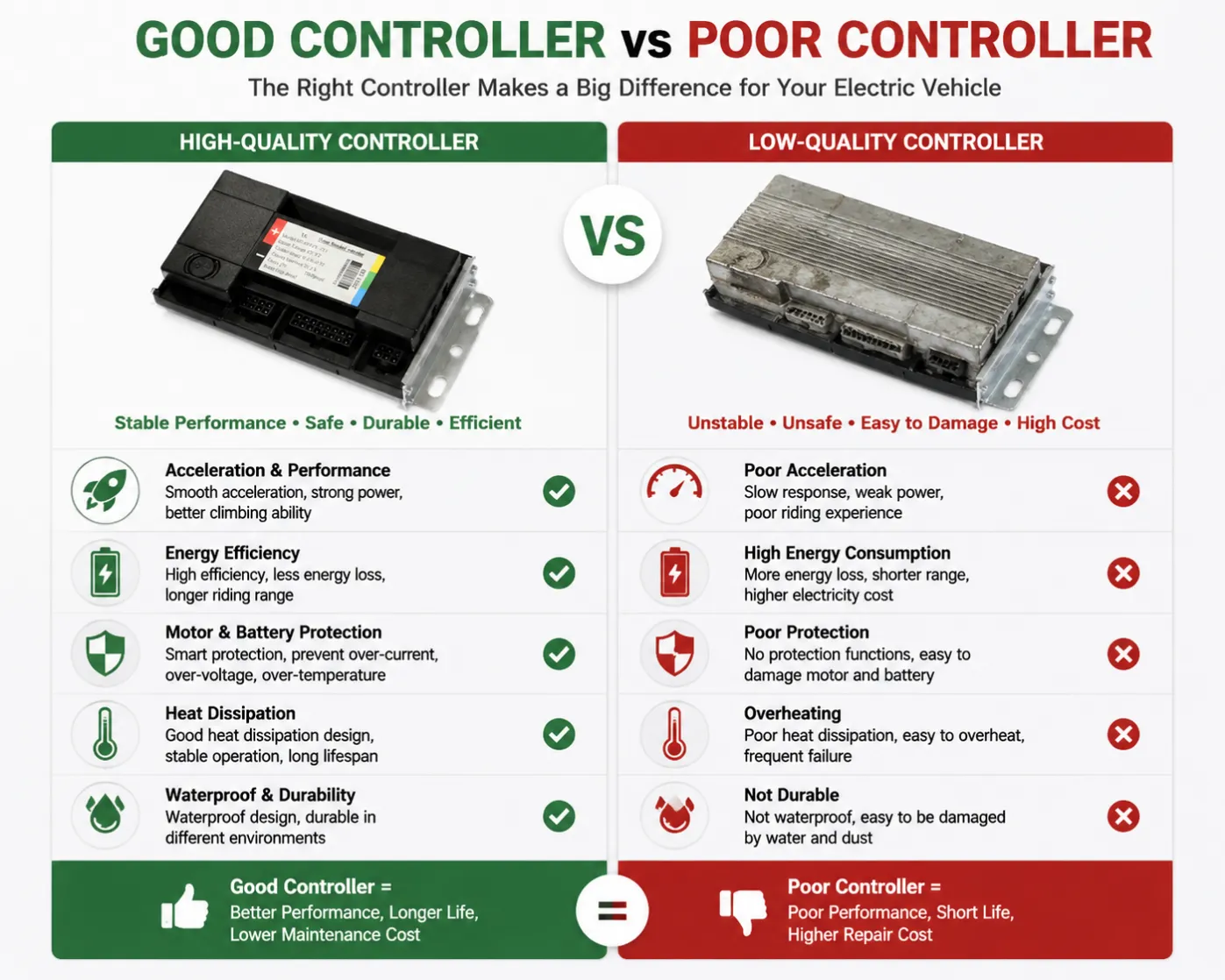
When buying an electric scooter, electric motorcycle or electric tricycle, most customers focus on motor power and battery capacity. However, the electric vehicle controller is equally important. As the "brain" of an electric vehicle, the controller manages power output between the battery and motor, directly affecting acceleration, efficiency, riding experience and vehicle reliability. Choosing the right controller can improve performance and reduce maintenance costs.
For an importer, distributor, or dealer, this choice matters even more than it does for a single rider. A rider who chooses the wrong controller has one vehicle to fix. A buyer who orders the wrong controller specification for a whole shipment has a warehouse of vehicles that feel weak on the road, run hot in daily use, or come back under after-sales complaints. The controller is a small, relatively low-profile part, but it decides how the motor and battery you have already paid for actually behave together. That is why experienced overseas buyers treat controller selection as a specification decision to confirm in writing before production, not as a standard part to leave to chance.
1. What Does an Electric Vehicle Controller Do?
An electric vehicle controller controls the power flow from the battery to the motor. It manages: Speed control; Acceleration; Current output; Motor protection; Battery protection. A well-designed controller ensures the motor, battery and electrical system work together efficiently.
In practical terms, every time the rider twists the throttle, the controller is the part that decides how much current to release, how quickly to release it, and when to limit it to protect the system. That is why two electric two-wheelers with the same motor power and the same battery capacity can feel completely different on the road. One pulls away smoothly and holds speed steadily on a slope. The other jerks at low speed, feels flat when the rider asks for more power, or cuts out under load. Very often the difference is not the motor. It is the controller matching, the controller settings, and the quality of the components inside the controller box.
A useful diagnostic habit for buyers is to test this on a sample vehicle before placing a larger order. Ride the sample at low speed in a car park or quiet yard and notice whether acceleration is smooth or snatchy. Ride at a steady medium speed and notice whether power delivery feels stable or surging. Ride up a familiar slope with a normal load and notice whether the vehicle maintains progress without sudden power loss or excessive heat from the controller area afterwards. None of these checks requires special equipment, and together they reveal more about controller quality than a specification sheet alone.
Why Is a Good Controller Important?
1. Better Performance — A high-quality controller provides: Smooth acceleration; Stable power output; Better climbing ability; Improved riding comfort. For delivery scooters and cargo electric tricycles, stable power control is especially important.
For commercial two-wheeler use, stable power control is what riders notice across a whole working day, not just in the first five minutes. A delivery rider makes dozens or hundreds of short starts, stops, and low-speed manoeuvres. If acceleration is harsh at every start, the vehicle is tiring to ride, harder to control in traffic, and harder on the drivetrain. If power fades or becomes inconsistent as the vehicle warms up, the rider loses confidence on slopes and when pulling away with a load box fitted. When you evaluate a sample for fleet or delivery use, do not only test it empty and cold. Test it in the condition it will actually work in: with the delivery box or normal carrying load fitted, after a period of continuous riding, and on the kind of slope your customers will meet daily. A good controller should still feel composed in those conditions.
2. Higher Energy Efficiency — The controller determines how efficiently battery power is converted into motor power. A good controller helps: Reduce energy loss; Increase riding range; Improve battery utilization.
Efficiency is easy to claim and harder to verify, so buyers should avoid judging it from a single short ride. A more reliable approach is a repeatable comparison. Charge the sample fully, ride a fixed route at a similar speed with a similar load, and record the distance covered and the battery level or voltage at the end. Repeat the same route in similar conditions if you are comparing two controller options. Keep the rider, route, load, and starting charge as consistent as you can. This will not give you a laboratory figure, and you should not present it as one to your own customers, but it will show you whether one setup consistently uses battery power more carefully than another on the roads your market actually uses. Also check the basics that waste energy quietly: connectors that are loose or oxidised, and a controller and motor pairing that forces the system to work harder than it needs to for ordinary riding.
3. Longer Motor and Battery Life — A reliable controller protects key components by controlling: Current; Voltage; Temperature. This reduces overheating and prevents unnecessary damage. Overheating easily makes motors break, especially on some climbing roads.
Protection only works when the whole system is matched. A controller cannot protect a motor it is badly paired with, and it cannot protect a battery if the voltage system is wrong from the start. This is why controller choice should never be made in isolation. On a climbing road, current demand rises, heat builds in the controller and the motor, and any weakness in matching or heat dissipation shows up first. For markets with hilly routes, long gradients, or regular passenger or goods carrying on a two-wheeler, buyers should raise this duty explicitly with the supplier before ordering. Describe the slope, the load, and the daily distance in writing, and ask the supplier to confirm in writing that the proposed controller and motor combination is suitable for that use. Verbal reassurance on a call is not enough when the vehicles will work far from the factory.
How to Choose the Right Electric Vehicle Controller?
1. Match Battery Voltage — The controller voltage must match the battery system. Common options: 48V; 60V; 72V. Incorrect voltage matching may cause system failure or damage.
This is the first check and the one that must never be guessed. Before you confirm any order, write down the battery system voltage for the exact model and version you are buying, and write down the controller voltage rating beside it. They must match. The same discipline applies when you later order spare controllers or replacement batteries as parts: a spare that looks the same and has the same connectors is not automatically the correct part if its voltage rating differs. A common and expensive mistake is mixing parts across versions of a similar-looking model, for example holding one pool of spares for both a 60V version and a 72V version and fitting them interchangeably in the workshop. Label spare controllers clearly by model and voltage as soon as they arrive, store them separately, and make the voltage check the first step in your workshop fitting procedure.
Buyers can use a concrete example from the Lubon range to see how this works in practice. The LB-CS product page states a 1500W motor with 60V/72V 32Ah battery options. That means the same model family can be supplied in different voltage configurations, so the controller must be specified for the exact configuration ordered, not assumed from the model name alone. When you request a quotation, state the voltage you want in writing. When you receive the proforma invoice and specification sheet, check that the battery option, the motor, and the controller are all listed consistently for that same voltage system. If any document shows a different voltage from the one you ordered, stop and clarify before payment or production, not after the vehicles arrive.
2. Match Motor Power — The controller should match the motor power. Example: A controller that is too weak limits performance, while an oversized controller may increase heat and cost.
Matching motor power is a balance, not a race for the biggest number. A controller that is too weak for the motor will limit performance: the vehicle may feel underpowered, struggle under load, and work at its limit for much of the time, which builds heat and shortens service life. A controller that is far oversized for the application is not automatically better either. It may increase heat and cost, and it can allow current levels that the rest of the system was not specified to handle comfortably in continuous use. The right question for a supplier is not simply what controller is fitted, but why that controller is matched to that motor for that intended use. Ask for the motor rated power and the controller specification together, in the same document, so you can see the pairing as a system.
A practical decision rule for dealers is to match the controller to the hardest normal job the vehicle will do, not to the easiest ride and not to an extreme the vehicle will rarely face. If the two-wheeler will be used for ordinary commuting on flat urban roads, the standard factory pairing is normally the starting point to evaluate. If it will carry a passenger regularly, work as a delivery vehicle all day, or operate on sustained slopes, say so before ordering and ask whether the standard pairing remains suitable for that duty, and confirm the answer in writing. Do not try to solve a duty problem later by fitting a much larger controller to a standard vehicle without supplier confirmation. Changing one part of a matched system changes the load on the other parts.
3. Check Motor Compatibility — Before purchasing, confirm: Motor type (BLDC motor); Voltage; Power rating; Connector type; Communication system. Compatibility is critical for stable operation.
Compatibility is where many avoidable workshop problems begin. Two controllers can share a voltage rating and still not be correct for a given motor because the connector type, wiring arrangement, or communication system differs. For an importer, the cost of this mistake is multiplied: the vehicles may be complete, but a batch of spare controllers that does not connect or communicate correctly is dead stock, and a workshop that discovers the mismatch only when a customer's vehicle is on the stand loses time and trust. Protect yourself with a simple pre-shipment routine. Ask the supplier to confirm in writing, for each model you order: the motor type, the voltage, the power rating, the connector type, and the communication system used between the controller and the rest of the vehicle. Ask for a clear photo of the controller label and its connectors for the exact version you are buying, and keep that photo with the model file. When spares arrive, compare the label and connectors against that record before the parts go into general stock.
If you sell more than one model, keep a separate compatibility record for each model and version. Do not rely on memory or on parts looking similar. A one-page record per model, listing the correct controller specification, voltage system, motor rating, and connector type, will prevent most fitting errors and will make training a new technician much easier. It also helps when you reorder months later, because staff change and memories fade, but a written record does not.
4. Choose Reliable Components — A quality electric vehicle controller should include: High-efficiency MOSFET components; Good heat dissipation design; Waterproof protection; Stable electronic components. These features improve reliability in different environments.
Component quality is harder for a buyer to see, because the important parts are inside a sealed box. You can still evaluate it with discipline. First, look at the outside: the casing, the heat dissipation design, and the quality of the sealing and cable exits tell you a lot about how seriously heat and water protection have been treated. Note that the correct standard here is waterproof protection and sealing as described for the product; do not assume or advertise a specific waterproof rating number unless the supplier has confirmed that exact rating in writing for that exact controller. Second, test behaviour over time, not just at first switch-on. Run the sample through repeated starts, a sustained ride, and a loaded climb, then check whether the controller area has become excessively hot and whether performance has changed. Third, ask about consistency. For a distributor, one good sample is not enough if production units vary. Ask the supplier to confirm in writing that production controllers will use the same key component specification as the sample you approved, and keep your approved sample or its full specification record as the reference for later shipments.
Common mistakes in this area include choosing on price alone, approving a sample without recording its specification, and assuming that a controller that works well in mild, dry, flat test conditions will behave the same in a hot, wet, hilly market. Your test conditions should resemble your market as closely as you reasonably can. If your customers ride in heavy rain, test wet-weather care and storage routines and discuss water exposure honestly with the supplier. If your market is hot, pay particular attention to heat dissipation and to where the controller is mounted on the vehicle and whether that position has airflow in normal use.
Problems Caused by Poor Controllers — Low-quality controllers may result in: Weak acceleration; Shorter riding range; Motor overheating; Frequent failures; Higher maintenance costs. For commercial electric vehicles, a reliable controller can significantly reduce operating costs.
For a dealer, these problems rarely arrive one at a time, and they rarely stay as purely technical problems. Weak acceleration and shorter range become customer complaints. Motor overheating becomes a workshop job. Frequent failures become spare-parts cost, technician time, and vehicles off the road. Higher maintenance costs then become a reputation cost, because a customer who has returned twice with electrical problems tells other riders about the experience, not about the specification decision that caused it. That chain is why the cheapest controller option can be the most expensive choice over the life of a shipment. When you compare two quotations, compare them as total ownership propositions: the purchase price, the expected failure pattern, the availability and price clarity of matching spare controllers (confirm spare availability in writing before you need it urgently), and the ease of correct fitting in your own workshop. A slightly higher unit price for a properly matched, well-made controller is usually easier to defend to your own customers than repeated failures on a cheaper one.
Before you place a volume order, use a written confirmation list with your supplier. At minimum, confirm in writing: the model and version; the battery system voltage, from the 48V, 60V, and 72V systems used across the range, that applies to your order; the battery capacity option selected; the motor type and rated power; the controller voltage, power matching, connector type, and communication system; the intended use, including load, terrain, and daily distance; the spare controller specification for reordering; and the controller quantity included as spares, if any. Keep the supplier's reply with the order file. If a dispute or a fitting problem arises later, that written record is what allows both sides to solve it quickly and fairly.
Lubon provides reliable controller solutions for: Electric scooters; Electric motorcycles; Electric tricycles; Delivery vehicles.
With experience in electric vehicle manufacturing, Lubon helps global distributors and vehicle manufacturers build reliable EV solutions.
If you are preparing an enquiry to Lubon or to any supplier, get the most useful reply by sending complete information in the first message. State the model you are interested in, the voltage system and battery option you want, the motor power, how the two-wheeler will be used, the terrain and typical load, your estimated quantity, and whether you also need matching spare controllers for your workshop. Complete enquiries get accurate, comparable quotations. Vague enquiries get vague answers, and vague answers are where mismatched controllers begin.
At The End — A good electric vehicle controller is not just an electrical component — it is the key to vehicle performance and reliability. When choosing an electric scooter controller or electric tricycle controller, always consider: Voltage matching; Motor compatibility; Quality components; Application requirements. Choosing the right controller means better performance, lower maintenance and a longer-lasting electric vehicle.
The short version for busy buyers is this: match the voltage first, match the motor second, verify compatibility in detail third, and judge component quality by tested behaviour and written specification, not by appearance or price alone. Test the sample in conditions that resemble your market, record the approved specification, label your spares by model and voltage, and train your workshop to check voltage and connectors before fitting. Those five habits cost very little, and they prevent most of the controller problems that distributors later pay heavily to fix.
Contact Lubon for customized EV controller solutions.
Email: saravehicle@jxlubon.com Tel: +86 18970353905 ADD: Anzhen, Xishan District, Wuxi City