
Spare Parts Shortages Kill Electric Two-Wheeler Sales: What Importers Must Confirm Before Ordering
The vehicle price is only part of the deal. Controllers, chargers, batteries and wear parts decide your after-sales costs. Confirm this spare-parts checklist before ordering an electric motorcycle.
The vehicle is not the hard part — keeping it running is
Many first-time importers negotiate hard on the unit price of an electric motorcycle, then lose far more money in the first year because of one missing item: spare parts.
A bike that waits six weeks for a controller is not just a warranty cost. It is a customer telling everyone in the market that your brand cannot be repaired.
Look at how that cost actually builds. The vehicle itself is a one-time negotiation, settled before shipping. Parts are a cost that repeats for as long as the vehicles are on the road — and it repeats in the worst possible way, one urgent request at a time. A single failed part on a working vehicle can mean emergency air freight for one small box, workshop time spent diagnosing a problem you cannot finish, a loan vehicle or a refund to keep the customer calm, and a rider who needs that vehicle for work losing income while it sits in your shop. None of those figures appears in the unit price you negotiated so hard.
There is a quieter cost as well. Local repair shops and mechanics decide which brands they are willing to recommend. A mechanic who has been left waiting for parts twice will steer the next customer to a brand he can repair the same day — and that recommendation, repeated in a market town after town, is worth more than any advertising you will buy. Spare parts are therefore not an after-sales detail. They are part of the product you are selling, and they should be negotiated with the same seriousness as the vehicle itself, at the same time, in the same written order.
The first-time importer's most common mistake is timing: parts are discussed after the vehicles are already sold, when the first failure has happened and the customer's patience is already being spent. By then your choice is between expensive emergency freight and a damaged reputation. Everything in this article is about moving that conversation to before the deposit, when you still have leverage and the parts can travel cheaply, by sea, in the same container as the vehicles.
The parts that actually fail — and get requested
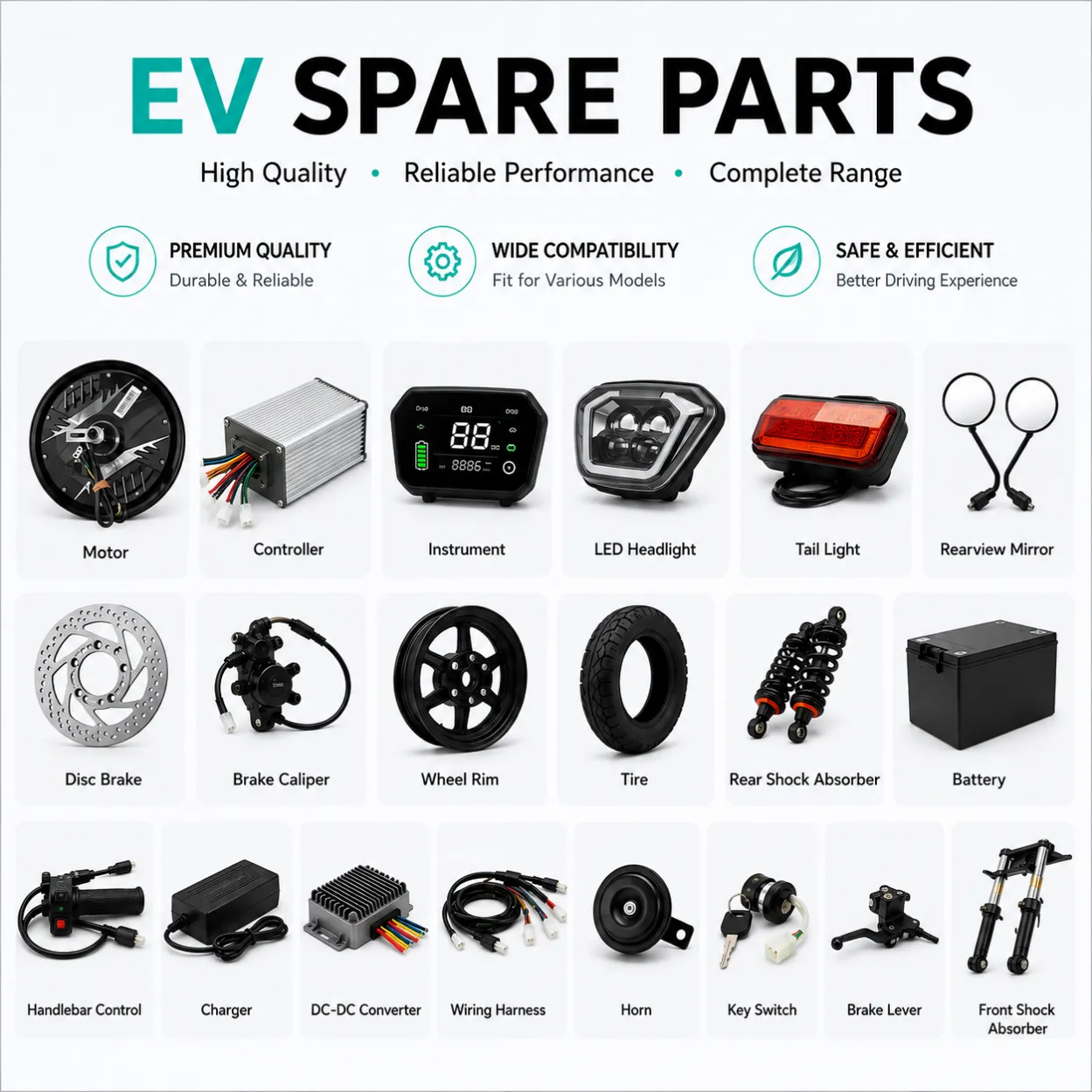
In normal commercial use, the most requested electric two-wheeler parts are not exotic:
- Chargers — damaged cables, wrong plugs, and chargers that do not match local voltage habits. Chargers live a hard life: carried on the vehicle, dropped, pulled by the cable, and plugged into whatever socket is available. They are also configuration-specific — a charger must match the battery it serves — so "any charger" from a local shelf may not be a safe substitute. Stock the exact charger supplied with your configuration, and confirm the plug and voltage for your market before shipping, not after arrival.
- Controllers and throttles — sensitive to water ingress, overload and mismatched replacement parts. A controller is matched to the motor and battery configuration of the vehicle. A replacement with the wrong specification can perform badly or fail again, which is why part numbers matter more than part names: record the exact part fitted to each batch you import, with a photo, so a replacement order can be matched precisely instead of described from memory.
- Brake pads, tyres, cables and switches — ordinary wear items your customers expect to buy the same day. These are not warranty items; they are your easiest repeat business — but only if they are on your shelf. A rider who cannot buy brake pads from you today buys them somewhere else, and may not come back to you for anything else either.
- Batteries and BMS — the most expensive item, and the one where compatibility matters most. A battery is not interchangeable just because the voltage matches: capacity, physical fit, connectors and the battery management system all have to match the vehicle and its charger. This is the part where a wrong substitution costs the most, so confirm compatibility in writing and keep the specification of the packs you imported on file.
- Locks, mirrors, lamps and body panels — small parts, but a missing one keeps a vehicle off the road. These are also the parts most likely to differ between model years or batches, even when the model name stays the same. A photograph of the fitted part, taken from your own stock when the container arrives, is worth more than a description when you come to reorder.
If a supplier cannot supply these consistently, the original vehicle price does not matter.
A useful way to organise this list is by how a missing part behaves in your market. Fast-moving wear items — brake pads, tyres, cables, switches — must never be out of stock; they are cheap, predictable and needed constantly. Failure items — chargers, controllers, throttles — are needed less often but stop the vehicle completely, so a small stock of each, matched to your batches, is insurance you buy once. Damage items — mirrors, lamps, panels, locks — are unpredictable in which side or colour is needed, so identifying them precisely matters more than holding large numbers. Thinking in those three groups turns a long parts list into a stocking plan you can actually budget for.
Six questions to ask before you pay a deposit
- Is there a written spare-parts list with prices? Not "we support parts" — an actual list, item by item, that you can order from later. The list should identify each part clearly enough that both sides mean the same item: model, description and, where it matters, a part number or photo. Keep the list with your order documents. If a verbal promise and a written list ever disagree, the list is what your next order will actually be priced from.
- What percentage of parts should I order with the vehicles? Experienced importers typically order a parts package together with each shipment instead of waiting for failures. Ask the supplier to propose a package for your order size and market, in writing, and judge it against the three groups above: enough wear items to sell from day one, a protective stock of the failure items that stop vehicles, and the means to identify damage items quickly. A supplier who sells into export markets regularly will have a view on this; a supplier who has none is telling you something about their after-sales experience.
- Will this model stay compatible? If the factory changes a controller or battery mid-year, will parts for your earlier batches still be available? Models evolve, and that is normal — the risk is silent change. Ask how you will be told if a fitted part changes, and confirm that parts for the configuration you bought will remain orderable. Your own batch records — part numbers and photos, taken on arrival — are your protection here, because they let you prove exactly what your vehicles were built with.
- What is the parts lead time, separately from vehicle lead time? These are two different numbers and they are often confused. A model's product page may state vehicle delivery — our LB-CS page, for example, states delivery in 15 days — but that is the vehicle figure, not a promise about a later parts shipment. Confirm the parts lead time in writing, for both a parts package shipped with vehicles and a standalone parts order shipped later, so you can plan stock instead of improvising around failures.
- How are warranty claims handled? Photo/video evidence? Replacement in the next shipment, or immediate dispatch? Who pays the freight? Get the process, not just the assurance: what evidence you must supply, how a claim is approved, whether the replacement travels with your next order or on its own, and who bears each freight cost. No warranty period is published on our site, so confirm the warranty terms themselves in writing as well — what is covered, for how long, and under what conditions — before you repeat any promise to your own customers.
- How are vehicles and parts packed for sea freight? Salt air, humidity and stacking damage are leading causes of "dead on arrival" complaints. Ask for packing photos before shipment, not after. Extend the same question to the parts themselves: small parts should arrive identified and protected, so your stockroom receives orderable items, not an anonymous carton to be sorted and guessed at. When the container arrives, photograph and log the parts against the written list immediately — that log is the baseline for every warranty claim and reorder that follows.
A simple rule for your first order
Budget for parts and after-sales from day one, agree the parts list and warranty process in writing, and put a sample of fast-moving parts in the same container as the vehicles. Distributors who do this spend less on emergencies — and sell more, because local shops are willing to recommend a brand they can actually repair.
Make the rule operational with three small habits. First, keep a simple parts record for every batch: model, configuration, part numbers, and photos of the charger, controller and battery fitted to that batch. Second, keep a claims and requests log from the first sale — which parts customers actually ask for, and how often — because after one season that log, not guesswork, should set the size of your next parts package. Third, agree with your own workshop what "repaired same day" means for the common failures, and stock to that promise. A brand that can honestly offer fast repair on the parts that fail most often has a sales argument its competitors without parts cannot copy.
That is also how we suggest you work with us. Ask for the vehicle quotation and the matching spare-parts list together, tell us which configurations you plan to stock, and confirm the parts lead time, the compatibility position for your batch, and the warranty process and terms in writing before you pay a deposit. Lubon is based in Jiangxi, and its electric two-wheelers are produced at our Wuxi base. Send us your target model and order quantity, and we will work through the parts list with the quotation, so the after-sales side of the deal is agreed while everything is still on paper — where it is cheapest to fix.
Planning an electric two-wheeler order? Ask us for the vehicle quotation and the matching spare-parts list together, so you can see the full cost before you commit: email saravehicle@jxlubon.com or WhatsApp +86 189 7035 3905.