
Electric Scooter Spare Parts and Customs: What African Importers Should Plan Before the Container Arrives
A scooter without parts is a scooter off the road. The spare-parts list, customs documents and port checks African importers should settle before ordering.
The part that stops the sale is rarely the scooter
A dealer can sell the first scooter on price, looks and a good test ride. The second sale, and the third, depend on something much less visible: whether a worn tyre, a tired brake pad or a broken cable can be replaced quickly and at a fair price. In many African markets, that is where electric scooters win or lose. A petrol bike has a parts shop on nearly every busy street, built up over decades. An electric scooter is new, and its parts chain has to be built deliberately, order by order, before the first customer needs it. For an importer, that means spare parts are not an afterthought to the vehicle order. They are part of the order. The parts list, the prices, the documents that get the parts through customs, and the plan for what happens at the port all need to be settled before the container leaves the factory. A scooter that waits weeks for a small part is a scooter that stops earning, and a customer who waits weeks will not recommend the brand to anyone. Plan the parts chain first, and the vehicle sales will follow.
The parts that wear first — and the parts that strand a scooter
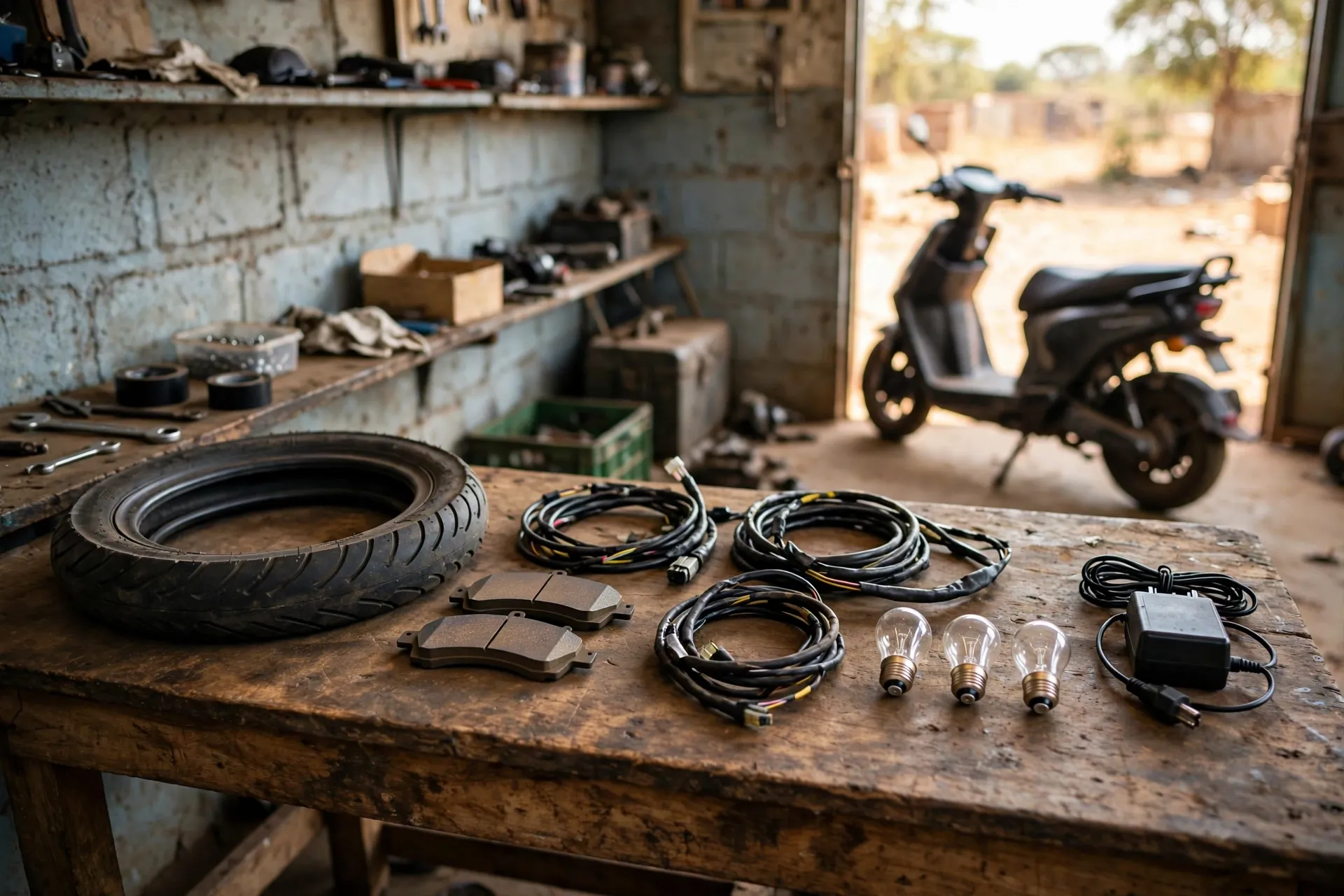
Not all spare parts matter equally. A dealer should think in three groups: the parts that wear out in normal use, the parts that break and strand the scooter, and the parts that rarely fail but take the longest to replace. The wear parts come first, because they are the parts every customer will need. Tyres wear fastest on rough roads and under constant two-up loads, so the exact tyre size for your model should be on the first parts order. Brake pads, cables and discs wear fast in stop-start traffic. Light bulbs, switches, mirrors, seat covers and footrests take daily knocks from passengers and parking. These are small, cheap parts, but a scooter without a working brake or a working light is a scooter off the road, and a rider who cannot buy a tyre from you today will buy it from whoever has one. The second group is the parts that strand a scooter when they fail: the charger, the controller, the throttle and the key electrical connectors. A failed charger is the most common example. The scooter is otherwise fine, the battery is fine, but nothing moves until a new charger arrives. That is why the charger should be on your first parts order, even though it is not a wear part. The same applies to the controller and the throttle. Order at least one of each with the vehicles, and confirm in writing that they match the exact model and battery configuration on your order, because a charger built for one battery chemistry must not be used on the other, even when the voltage number looks the same. The third group is the slow parts: body panels, the seat assembly, the motor and the battery itself. These fail rarely, but they take the longest to supply, and they are the parts a customer will ask about when something serious happens. You do not need to stock all of them on day one. You do need to know, in writing, whether the factory can supply them, how they are packed, and how they ship — and whether a battery ships inside the vehicle or separately, because that changes the documents and the packing.
The written spare-parts list
Before you pay for a container, ask the factory for the written spare-parts list for your exact model, with prices. The list should name every part, give its price, and say which parts the factory recommends stocking for your market. Lubon keeps spare parts in their own Spare Parts category, and loading photos are provided before shipment, so you can check the parts against the order before it leaves. Compare the list against your own market: if your roads are rough, order more tyres and suspension parts; if your riders carry passengers all day, order more brake parts and seat parts. Ask the factory how parts orders work after the first container. Can you order parts on their own, or only with vehicles? Is there a minimum quantity for a parts order? How are parts packed — labelled per model, or loose in a carton? A parts order that arrives unlabelled and mixed across models is a parts order you cannot sell from. Get the answers in writing, and keep them with the order file. Where the factory cannot give a parts lead time in writing, treat that as a gap and say so in your own planning, rather than promising your customers a date you do not have.
Customs documents: what to ask the factory for
Customs clearance is where many first orders lose their first week. The documents are not complicated, but they have to be right, and they have to be requested before the goods ship, not after the container reaches the port. Ask the factory, in writing, for the full document set for your order: the commercial invoice, the packing list, the bill of lading, the certificate of origin, and the factory's product documentation for the vehicles and the batteries. For the batteries, ask what documents travel with them and whether the battery ships inside the vehicle or separately, because the documents and the packing depend on it. Ask whether the factory has supplied your country before, and if so, which documents the customs office there asked for on that shipment. A factory that has shipped to your market before can save you a week of questions. Do not assume the duty and tax treatment. Rates, exemptions and inspection rules differ by country, and they change. Confirm in writing before ordering what applies to your shipment, through your own customs broker or clearing agent, not through a figure quoted in a sales message. Your broker is the person who knows your port. Ask the broker what the customs office will ask for, what the inspection looks like, and what happens if a document is missing or a description does not match the goods. Then ask the factory to match exactly that document list, word for word, before the container is loaded.
The port: inspection, storage and the first ride home
The container does not end its journey at the port. It ends it at your shop, and the gap between the two is where costs and damage hide. Ask your clearing agent how long clearance usually takes at your port, what the storage charges are if the container waits, and what inspection the customs office or the port authority carries out. Some ports inspect every container; some sample; some require the vehicles to be checked before release. Know which one yours is, and plan the transport and the warehouse space around it. When the container is opened, check the goods against the packing list before they leave the port area, and photograph anything that looks damaged or short. Loading photos from the factory are provided before shipment, so compare what arrives with what was loaded. If a vehicle is damaged in transit, the photographs and the packing list are the evidence you will need, so take them before the goods are moved, not after. Confirm in writing with the factory what to do if goods arrive damaged or short — who to contact, what evidence to send, and what the factory will do — before the container ships, because that conversation is much harder after the money is paid and the goods are in your yard.
What to get in writing before the container
Spare parts and customs are both settled by the same habit: get it in writing before you pay. Before your order leaves the factory, put these in writing.
- The written spare-parts list for your exact model, with prices, and which wear parts the factory recommends stocking first.
- The charger, controller and throttle for your exact model and battery configuration, ordered with the vehicles.
- The full customs document set: commercial invoice, packing list, bill of lading, certificate of origin, and the battery documents, matched to what your broker says your port requires.
- Whether batteries ship inside the vehicle or separately, and how they are packed.
- The duty and tax treatment for your country, confirmed through your own broker, not assumed from another market.
- What to do, step by step, if goods arrive damaged or short — who to contact, what evidence to send, and what the factory will do.
- The delivery terms for your order — Lubon offers CKD supply with a 15-day lead time on the listed configuration, and samples are available before a main order, so confirm the exact terms for your quantity in writing.
A scooter that can be repaired quickly, at a price your customers accept, is a scooter that earns its keep for years. Stock the wear parts, order the parts that strand a scooter, settle the documents before the container ships, and know your port before the container arrives. That is how a dealer turns a first container into a parts business that keeps customers coming back.
Talk to our team
Tell us where your scooters will run and which parts your market wears out first, and we will confirm the spare-parts list, documents and delivery terms for your order in writing before you order: contact us.