
Local CKD Assembly in Africa: What Electric Scooter Importers Should Settle Before the First Kit Arrives
Assembling scooters locally can cut costs and build a real business — if the kits, the workshop and the training are agreed in writing first.
Why importers look at local assembly
For many African importers, the first order is a finished scooter in a container. The second question, once the first scooters sell, is usually the same: could we assemble them here instead? Local assembly — CKD, or completely knocked down kits — can change the economics of the whole business. Kits take less container space than finished vehicles, the work creates local jobs, and a workshop that assembles scooters can also repair them, which is exactly the service customers ask for first. In some markets the duty treatment of kits also differs from that of finished vehicles, though that depends on the country and must be confirmed through your own broker, never assumed from another market.
But assembly is also where a good importing business can go wrong quickly. A kit that arrives with missing parts, no assembly manual, or fasteners that do not match the frame will stop a workshop for days. A team that has never assembled an electric scooter will make mistakes that a finished-vehicle importer never sees — a wrongly connected controller, a battery fitted the wrong way round, a brake that was never tested. This article sets out what to settle with the factory before the first kit ships, so the workshop opens with a plan instead of a problem.
What a CKD kit should contain — and what to ask in writing
A CKD kit is not one box of parts. It is a complete scooter, taken apart to an agreed level, with every part needed to put it back together. Before you order, ask the factory, in writing, for the exact kit contents list: frame, front fork and handlebar, wheels and tyres, motor, controller, battery, charger, lights, switches, cables, seat, body panels, mirrors, fasteners and the assembly manual. Ask which parts arrive already fitted together and which arrive loose. Ask how the kits are packed — labelled per kit, or mixed across kits in one carton — because a workshop that has to sort mixed parts across ten kits loses a day before it starts.
Ask for the assembly manual before you pay, not after the kits arrive. A good manual shows each step with pictures, names the tools, gives the torque or tightening order for the important fasteners where the factory specifies one, and shows the wiring diagram for the controller, battery and lights. Ask whether the manual is in English and whether the factory will send a video of the assembly as well. If the manual is only in Chinese, or only a few pages long, say so in your planning and ask for a better one — a workshop cannot build a safe scooter from guesswork.
Samples matter even more for kits than for finished scooters. Lubon offers CKD supply with a 15-day lead time on the listed configuration, and samples are available before a main order. Order a sample kit first and assemble it in your own workshop, with your own team, using only the manual and the tools you will have on the line. Time every step. Write down every part that was missing, unclear or hard to fit. That sample build is your real cost and time estimate — not the number in a sales message. Confirm the exact terms for your quantity in writing before the main order.
The workshop: space, tools, power and people
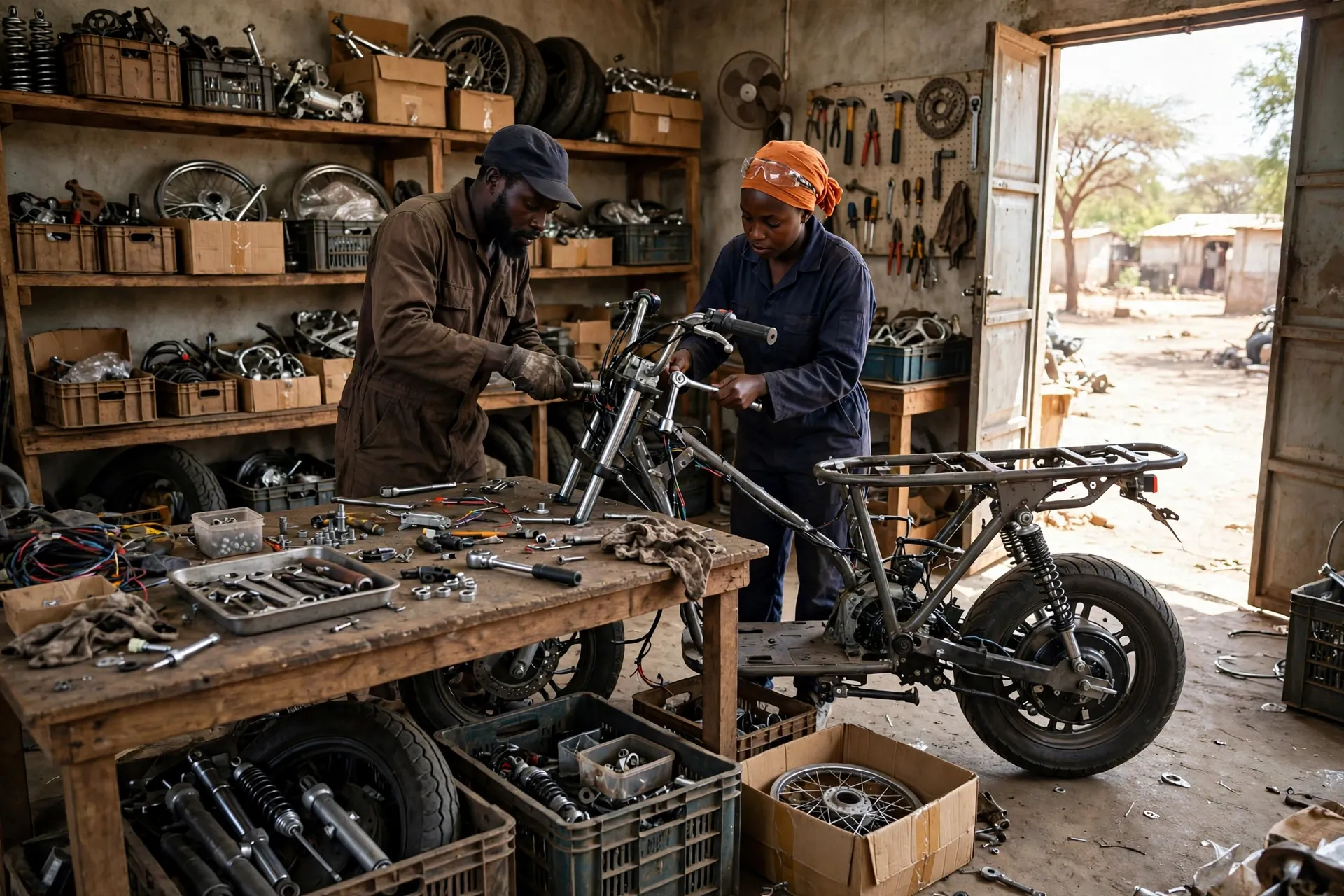
A CKD workshop does not need to be large, but it does need to be organised. You need a dry, covered floor with room to lay out one kit at a time, benches for the small work, a stand or lift for the scooter, and racking for parts so that nothing is lost on the floor. You need reliable light and a stable power supply for testing and charging — in markets with load shedding, plan the charging and testing work around the power you actually have, and keep a record of which hours the workshop can test a scooter and which it cannot.
Tools are a real cost, and they should be on the first order list, not bought one by one later. Ask the factory which specialist tools the assembly needs — for the motor, the controller connectors, the battery and the brakes — and whether those tools are included in the kit or must be bought separately. Standard spanners and screwdrivers cover much of the work, but the electrical checks need a multimeter and the right crimping tools, and the battery work needs insulated tools. Get the tool list in writing and check it against what your team already owns before the kits arrive.
People matter more than tools. Assembly is skilled work, and the team that assembles a scooter is responsible for its safety. Start with a small team — two or three people who can learn together — and train them on the sample kit before the main order arrives. Ask the factory whether it offers training: an assembly video, a video call walkthrough, or a visit from a technician. Get the training offer in writing, with dates, and keep it in the order file. If the factory cannot offer training, budget time for your own team to learn on the sample, and do not promise a delivery date until the sample build is finished and timed.
Quality checks: the step that protects the brand
Every assembled scooter must be checked before it leaves the workshop, and the check must be written down. Build a simple checklist and use it on every unit, with the assembler's name and the date on each sheet. At minimum, check that every fastener is tight, the brakes work on both wheels, the throttle responds smoothly, the lights, horn and indicators work, the battery charges in the normal 4–6 hours for the listed configuration, and the scooter runs without unusual noise or vibration on a short road test. Check the battery connections and the controller wiring against the diagram on every unit, not just the first one — wiring mistakes are the most common assembly error and the most dangerous.
Keep the checklist with the scooter's records. When a customer comes back with a problem, that sheet tells you whether the fault came from the factory, the assembly or the road — and it tells the factory the same thing when you report it. Loading photos are provided before shipment, so compare what arrives with what was loaded, and photograph any kit that arrives damaged or short before you start work on it. Confirm in writing with the factory what to do if a kit arrives damaged or short, or if a part is wrong for your model — who to contact, what evidence to send, and what the factory will do — before the container ships.
What to get in writing before the first kit
Local assembly rewards the importer who plans it like a small factory, not like a bigger container order. Before your first kit order, put these in writing.
- The exact kit contents list for your model, with the packing method and the labelling per kit.
- The assembly manual in English, with pictures and the wiring diagram, received before you pay.
- The sample kit assembled and timed in your own workshop, with every missing or unclear part recorded.
- The tool list, and whether specialist tools are included in the kit or bought separately.
- The training offer from the factory, with dates, and who on your team will be trained.
- The quality checklist your workshop will use on every assembled scooter, and who signs it.
- The delivery terms — Lubon offers CKD supply with a 15-day lead time on the listed configuration, and samples are available — confirmed for your exact quantity.
- The duty and tax treatment for kits in your country, confirmed through your own broker, not assumed from finished vehicles or another market.
- What to do, step by step, if a kit arrives damaged, short or with a wrong part.
A workshop that assembles its own scooters is a business that can repair them, stock their parts and train its own people. That is a stronger business than a container of finished vehicles alone. Settle the kit list, the manual, the tools and the training in writing first, build the sample slowly and check every unit — and the first kit will be the start of a workshop, not the start of a problem.
Talk to our team
Tell us where your workshop is and how many kits you plan to assemble, and we will confirm the kit contents, manual, training and delivery terms for your order in writing before you order: contact us.