
After-Sales Service for Electric Scooters in Africa: How Dealers Build a Workshop Customers Trust
The sale ends at the shop door; the service keeps the customer. How African dealers set up a workshop, stock parts and handle repairs.
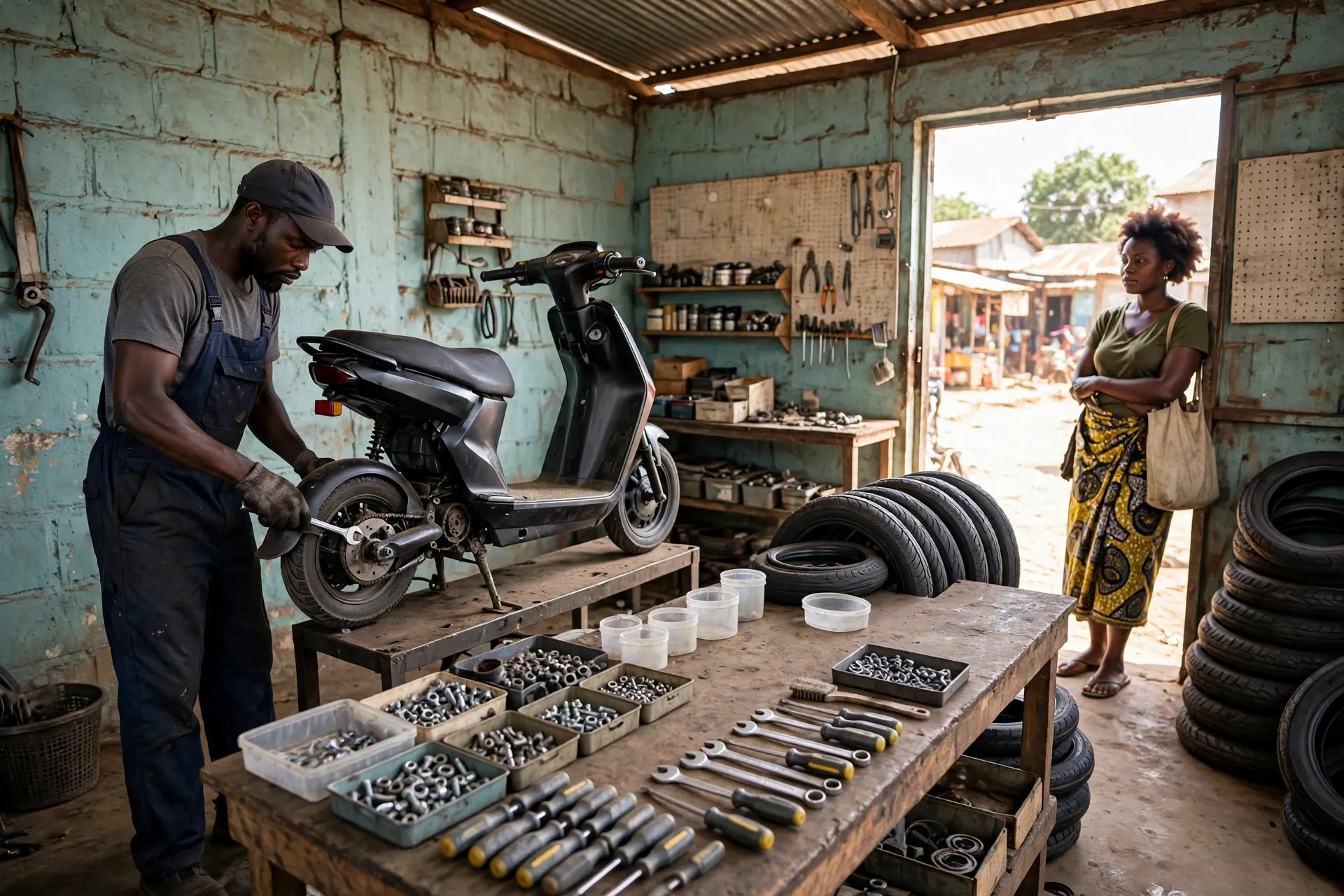
The sale is the start, not the end
A customer who buys an electric scooter is not buying a finished product. They are buying years of daily rides, and every one of those rides depends on the dealer still being there when something wears out, breaks or stops working. In African markets, where a petrol bike can be repaired on almost any street, an electric scooter dealer is judged by one thing above all: can you fix it, quickly, and at a fair price? A dealer who can will sell the second scooter to the same family and the third to their neighbour. A dealer who cannot will watch the first sale become the last.
After-sales service is therefore not a cost to be kept small. It is the part of the business that makes the sales keep coming. This article covers how a dealer sets up a workshop, what to stock, how to handle repairs, and what to agree with the factory — so that service becomes the reason customers choose you, not the reason they leave.
The workshop: what a dealer actually needs
A service workshop does not need to be big, but it needs to be ready. A dry, covered space with a bench, a stand or lift for the scooter, good light and a safe place to charge is the starting point. Keep the charging area separate from the wet work, on dry ground and under cover, with the charger out of puddles and direct rain. Give the charger air around it rather than wrapping it in plastic that traps heat and moisture, and keep the charging plug and socket dry. After a ride in heavy rain, let the scooter dry before plugging it in, and never charge a scooter standing in water or with a wet charger.
The tools for electric scooter service are part mechanical and part electrical. Spanners, screwdrivers and tyre levers cover the mechanical side. The electrical side needs a multimeter, insulated tools, the right crimping tools for connectors, and a clean, dry place to open a controller or check a battery. Ask the factory which specialist tools your models need and whether they are available with the parts order. Keep a simple record of which tool belongs where, because a workshop that loses its tools loses its working day.
One person should own the workshop. Even in a small shop, name one technician who is responsible for repairs, for the parts stock and for the repair records. Train that person on the sample scooter before the main order arrives — on the brakes, the tyres, the controller, the throttle and the battery connections — and ask the factory whether it offers training by video or video call. A technician who has taken a scooter apart and put it back together once will diagnose a fault in minutes; a technician who has not will guess, and guessing costs parts.
What to stock: the parts that earn the workshop its name
A workshop with no parts is a waiting room. Stock the parts your market wears out first, and keep the list short enough to manage. Tyres, brake pads, cables and discs wear fastest, especially on rough roads and in stop-start traffic with passengers. Light bulbs, switches, mirrors and connectors are small and cheap, but a scooter without a working light or a working brake is a scooter off the road. The charger, the controller and the throttle are the parts that strand a scooter when they fail, so keep at least one of each for your main model, and confirm in writing that they match the exact model and battery configuration — a charger built for one battery chemistry must not be used on the other, even when the voltage number looks the same.
Lubon keeps spare parts in their own Spare Parts category, and loading photos are provided before shipment. Ask the factory for the written spare-parts list for your exact model, with prices, before your first container, and compare it with your own market: rough roads mean more tyres and suspension parts; all-day passenger work means more brake parts and seat parts. Ask how parts orders work after the first container — whether you can order parts on their own, whether there is a minimum quantity, and how parts are packed and labelled. Where the factory cannot give a parts lead time in writing, treat that as a gap in your planning rather than promising your customers a date you do not have. Keep the parts on labelled shelves by model, and count them weekly — a parts shelf you cannot count is a parts shelf you cannot sell from.
Handling a repair: diagnose first, replace second
Most service mistakes come from replacing parts before diagnosing the fault. Build a simple habit: listen to the customer, ride the scooter if it runs, and check the cheap things first. A scooter that will not start may have a loose battery connector, a blown fuse or a tired switch — not a dead battery. A light that flickers may be a wet connector, not a failed lamp. A throttle that cuts out may be a worn cable. Check the battery connections, the charger and the connectors before ordering a new motor or controller, and write down what you found on every job.
Keep a repair record for every scooter: the customer's name, the model, the date, what was wrong, what was replaced and what was charged. The record does three things: it tells you which parts to stock next time, it tells the factory which faults are common on your model, and it gives the customer proof of what was done. When a fault may be a factory issue, photograph the part and its label, note the battery details, and report it to the factory with the repair record. Confirm in writing with the factory, before the first container, what to do when a part fails early — who to contact, what evidence to send, and what the factory will do — because that conversation is much harder after the scooter is already in your workshop and the customer is waiting.
Charging, batteries and the honest conversation
The battery is the part customers ask about most and understand least. Lubon models offer lithium-ion and lead-acid options in 60V/72V 32Ah, the battery on the listed configuration sits under the seat as a black rectangular metal box, and the listed configuration charges in 4–6 hours. Teach your customers the basics at handover: charge under cover on dry ground, let the battery cool before charging, keep the connectors clean and dry, and report a charger that becomes too hot to touch, smells, or cuts out part-way through a charge. Do not quote a water or dust protection rating for any model unless the factory has given it to you in writing for that exact model, and do not promise a battery life or a range figure the factory has not confirmed in writing for your model.
Honesty about the battery builds more trust than any promise. If a customer asks how long a battery lasts, say what the factory has confirmed in writing and what you have seen on your own sample — and say what you do not know. Customers forgive a dealer who says "confirm in writing before ordering" far more readily than one who promises a number and cannot deliver it.
What to get in writing before you open the workshop
Service is a promise, and a promise should be written down. Before your first scooters reach customers, put these in writing — for your own shop and with the factory.
- The written spare-parts list for your exact model, with prices, and the first stock order placed before the scooters arrive.
- The charger, controller and throttle for your exact model and battery configuration, in stock from day one.
- The workshop tool list, and the technician who owns the workshop, trained on the sample scooter.
- The repair record form your workshop will use on every job, and how faults are reported to the factory.
- The steps to follow when a part fails early — who to contact, what evidence to send, and what the factory will do.
- The delivery terms for your order — Lubon offers CKD supply with a 15-day lead time on the listed configuration, and samples are available before a main order, so confirm the exact terms for your quantity in writing.
A dealer with a working workshop, stocked shelves and an honest answer about the battery will sell more scooters than a dealer with a bigger showroom and no service at all. Open the workshop before the first customer needs it, stock the parts the road wears first, and write down every repair. That is how after-sales service turns one sale into a customer for years.
Talk to our team
Tell us where your workshop is and which parts your market wears out first, and we will confirm the spare-parts list, training and delivery terms for your order in writing before you order: contact us.