FAQ About Lubon Motor
Learn more about our company
Q1: What types of electric vehicles do you manufacture?
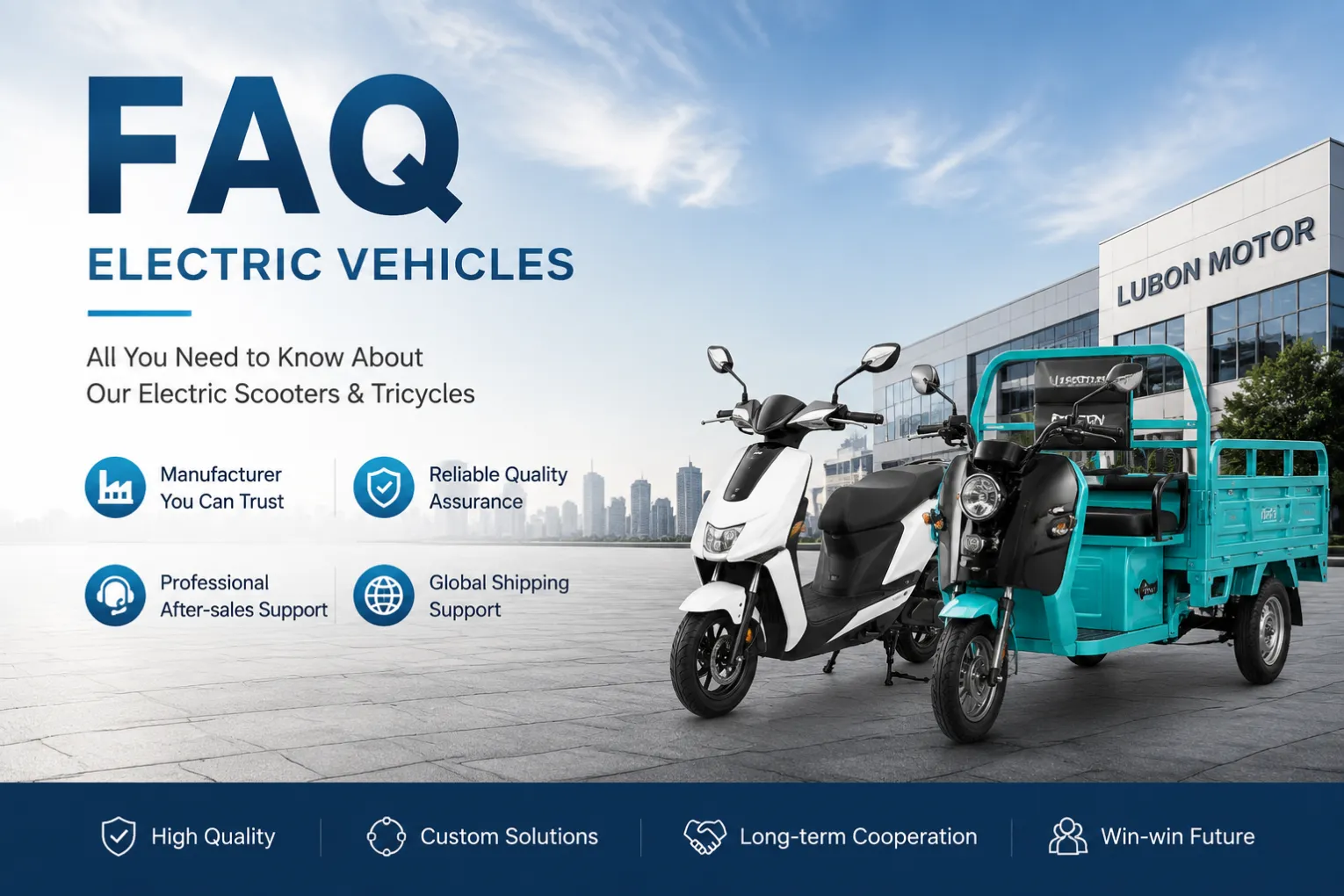
We manufacture: Electric scooters (include delivery scooter, urban scooter etc), Electric motorcycles, electric cargo tricycles. We support different applications including: Personal transportation; Food delivery; Logistics; Commercial transportation.
To choose well between these types, start from the job the vehicle will do every day, not from a photograph. Tell us who will ride it, what will be carried, how the vehicle will be charged, and whether it is for personal use, delivery work, logistics, or wider commercial use. A scooter chosen for short personal trips and a scooter chosen for full-day delivery work face very different demands, even if they look similar. Share your application in your first enquiry, and ask us to recommend a suitable type and configuration for that use — then confirm the recommended configuration in writing before you order.
Q2: Can you provide OEM and ODM electric vehicle services?
Yes. We support OEM and ODM services including: motor power and controller adjust, color and package design. Our team helps distributors create products suitable for their local markets.
In practice, a good OEM or ODM enquiry names exactly what you want changed and what must stay standard. List the items separately: motor power and controller adjustment, colour, packaging, and any branding or market-specific requirements you have in mind. Ask us to confirm, item by item and in writing, what can be done, what it depends on, and how it affects the minimum order quantity and the delivery time. A common mistake is to agree a custom project in general terms and discover late that one detail was assumed by one side and not by the other. An itemised written confirmation, checked before production, prevents that.
Q3: What is your minimum order quantity (MOQ)?
Our MOQ depends on the model and customization requirements. For standard models, we can support small trial orders. For OEM projects, MOQ depends on customization level. Please contact us with your target model and quantity.
When you ask about MOQ, send the target model, the quantity you are considering, and the level of customisation you need in the same message. That lets us give you a specific answer for your case instead of a general one. If you are new to a model, a sensible path is to discuss a small trial order or a sample first, evaluate the vehicle in your own market, and only then commit to a larger quantity. Confirm the agreed MOQ, the model, and the configuration in writing on the order itself, so there is no doubt later about what the quantity was agreed for.
Q4: What battery options are available for your electric vehicles?
We provide different battery solutions: Lithium battery; Lead-acid battery; Removable battery; High-capacity battery packs. Battery capacity can be customized according to your driving range, max load, and local regulations.
Treat the battery as a decision to make with your market in mind, not as a default. State the driving range you are aiming for, the load the vehicle will typically carry, and any local regulations you are aware of, and ask us to recommend a configuration. Then confirm the exact battery on your order — chemistry, voltage and capacity — in writing, and confirm that the supplied charger is matched to that battery. For reference, one of our listed models, the LB-CS, states a 1500W motor, lithium / lead-acid battery options at 60V/72V 32Ah, a max speed of 45 km/h, and a charging time of 4–6 hours; confirm the figures for the exact model and configuration you order, because options differ between models. Do not assume a battery fitted to one model can simply be swapped for another — ask first, in writing.
Q5: What's the max range for your scooter?
The driving range depends on the battery capacity, road condition, max load, motor power. Our engineers can recommend suitable configurations based on your market requirements.
Because range depends on those factors, be careful with any single range figure — including one you plan to print in your own marketing. The useful question is not "what is the maximum" but "what configuration suits my market's roads, loads and use". Give our engineers your real conditions: typical load, road condition, and how the scooter will be used day to day. Ask for a recommended configuration in writing, then test a sample under your own conditions before you make range claims to your customers. Testing locally, with your riders and your loads, gives you a claim you can stand behind; repeating a figure tested under different conditions is a common cause of disappointed buyers.
Q6: What certifications do your electric vehicles have?
Our electric vehicles can be supplied according to different market requirements. All scooter have CCC, some have CE, EEC, COC. We prepare the export documents to destination country request.
Read that answer carefully, because the detail matters. All scooters have CCC; only some models have CE, EEC or COC — it is not every model, and you should not assume it for the model you want. Before you order, name your destination country and the exact model, and ask us to confirm in writing which certifications and export documents apply to that model for that destination. Do the same check with your own local requirements on your side. Confirming this before a deposit is far easier than discovering a document gap after the goods are produced.
Q7: What's your delivery time?
Production time depends on order quantity and customization requirements. Normally 15 days. We provide production updates before shipment.
Use "normally 15 days" as the planning figure it is, and confirm the delivery time for your specific order in writing, because quantity and customisation requirements affect it. For the LB-CS, the product page also states delivery of 15 days. Ask, when you order, how production updates will be provided before shipment, and agree what you need to see — for example confirmation that production has started, and pre-shipment photos of the finished vehicles, packaging and key labels. If your own selling season or a customer deadline depends on the date, say so at the time of ordering, not afterwards.
Q8: How do you guarantee product quality?
We have strict quality control procedures including: Incoming material inspection; Battery testing; Motor testing; Controller testing; Road testing; Final inspection before shipment. Each vehicle is checked before delivery.
You can support that process from the buyer side. Agree the exact specification in writing before production, so inspections are made against a known standard rather than a memory of a conversation. Evaluate a sample before a larger order, and check it the way your customers will use it. For larger orders, discuss inspection arrangements and pre-shipment evidence with us in advance — what will be photographed, what will be checked, and how any problem found will be handled. A common mistake is to raise inspection requirements after production has finished, when options are limited. Raise them at the order stage, while everything can still be planned.
Q9: What after-sales support do you provide?
We provide: Warranty support; Spare parts supply; Technical guidance; Remote troubleshooting. For distributors, we can provide long-term cooperation support.
To make that support work, set it up before you need it. Ask for the spare-parts list for your model in writing before the main order, and discuss which parts you should keep in stock locally, so a rider is not left waiting for a small part. Agree how you will report a problem: which information, photos or videos you will send, and how remote troubleshooting will be handled. When a fault occurs, a clear report — model, what happened, when it started, and what you have already checked — gets a useful answer much faster than a general message. Keep records of issues from the first sale; patterns in those records are what turn individual fixes into lasting improvements.
Q10: Can you support CKD electric motorcycle projects?
Yes, we offer CKD or SKD or CBU condition, to meet local market requirement.
Choosing between CKD, SKD and CBU is a business decision as much as a product one. Think through your local assembly capability, your facilities and staff, your market requirement, and the cost and compliance picture for each condition before you decide — and confirm the current requirements for your exact model and market on your side. Ask us to state in writing what is supplied under the condition you choose, so you know exactly what arrives and what you are responsible for locally. If you are new to assembly, discuss training, manuals and technical guidance needs as part of the project discussion, and confirm what is included, in writing, rather than assuming it.
Q11: Can different models or colors be mixed in one order?
Yes, mix color and models are accepted.
Mixed orders are useful for a first container, because they let a distributor test more than one model or colour in a real market before committing deeply to one. Use that advantage deliberately: mix with a purpose, based on the customer groups you want to test, rather than a little of everything. List every model, colour and quantity clearly in writing on the order, and check that list again against the pre-shipment evidence. Mixed orders are where packing and labelling mistakes are easiest to make, on any supplier's side, so a careful written list and a careful check protect both sides.
Q12: Why choose a Chinese electric vehicle manufacturer?
China has a mature electric vehicle supply chain, allowing manufacturers to provide competitive prices, flexible customization, and reliable production capacity.
Those advantages are real, but they only reach you if you choose and manage a supplier well. A mature supply chain gives you choice of models, configurations and customisation — which is exactly why the written specification matters so much: with many options available, the order must state precisely which ones you chose. Judge a manufacturer on the clarity of its answers as well as its prices. A supplier that confirms charger, battery, certification, delivery and spare parts in writing, item by item, is showing you how your order will be handled. Lubon is based in Jiangxi, and its electric two-wheelers are produced at the Wuxi base, drawing on that mature supply chain — ask us about the model and configuration that fits your market, and judge the written answers for yourself.
Q13: What information should I send to get an accurate quotation?
Send your target model or vehicle type, the quantity you are considering, the battery option you prefer, your destination country and port, and any customisation you need. Add how the vehicle will be used — personal transport, delivery, logistics or commercial use — and your local plug type and any certification or document requirements you are aware of. The more complete that first message is, the more accurate the quotation can be, and the fewer rounds of questions are needed. Ask for the quotation to state clearly what is included, and confirm price, specification and delivery time in writing before you pay.
Q14: Should I order a sample before a bulk order?
For most new buyers, yes — a sample is the cheapest way to verify a model in your own market. Use it to check the things a catalogue cannot show you: the build and finish, the battery and charger labels against the written specification, the charging behaviour under your local power conditions, and the ride under your local roads and loads. Keep written notes and photos from your testing. If something differs from what was confirmed, raise it while you still only have a sample. Confirm the sample's model, configuration, price and delivery terms in writing before you pay for it, exactly as you would for a bulk order.
Q15: Which spare parts should I order with my first shipment?
Ask us for the written spare-parts list for your model before the main order, and discuss which items you should hold locally based on your market and expected use. Chargers are a sensible item to discuss for spares, because a failed charger strands an otherwise working scooter, and wear-and-service items are worth reviewing with us for the same reason. Confirm the parts, quantities and prices in writing as part of the order, rather than adding them as an afterthought after the container ships. Planning spares with the first shipment is far cheaper and faster than urgent small shipments later.
Email: saravehicle@jxlubon.com Tel: +86 18970353905 ADD: Anzhen, Xishan District, Wuxi City